
NotebookLM Is Not for Summaries: A Complete Study System in Eight Prompts That Test You and Expose What You Have Not Understood
Most students upload their files to NotebookLM, ask for a summary, then discover in the exam that they did not understand. This is an active study system in eight prompts: a course map, Socratic questions, explaining in your own words, past-exam analysis and the Studio tools.
 Mulk Allah Al-Sadi6 min read
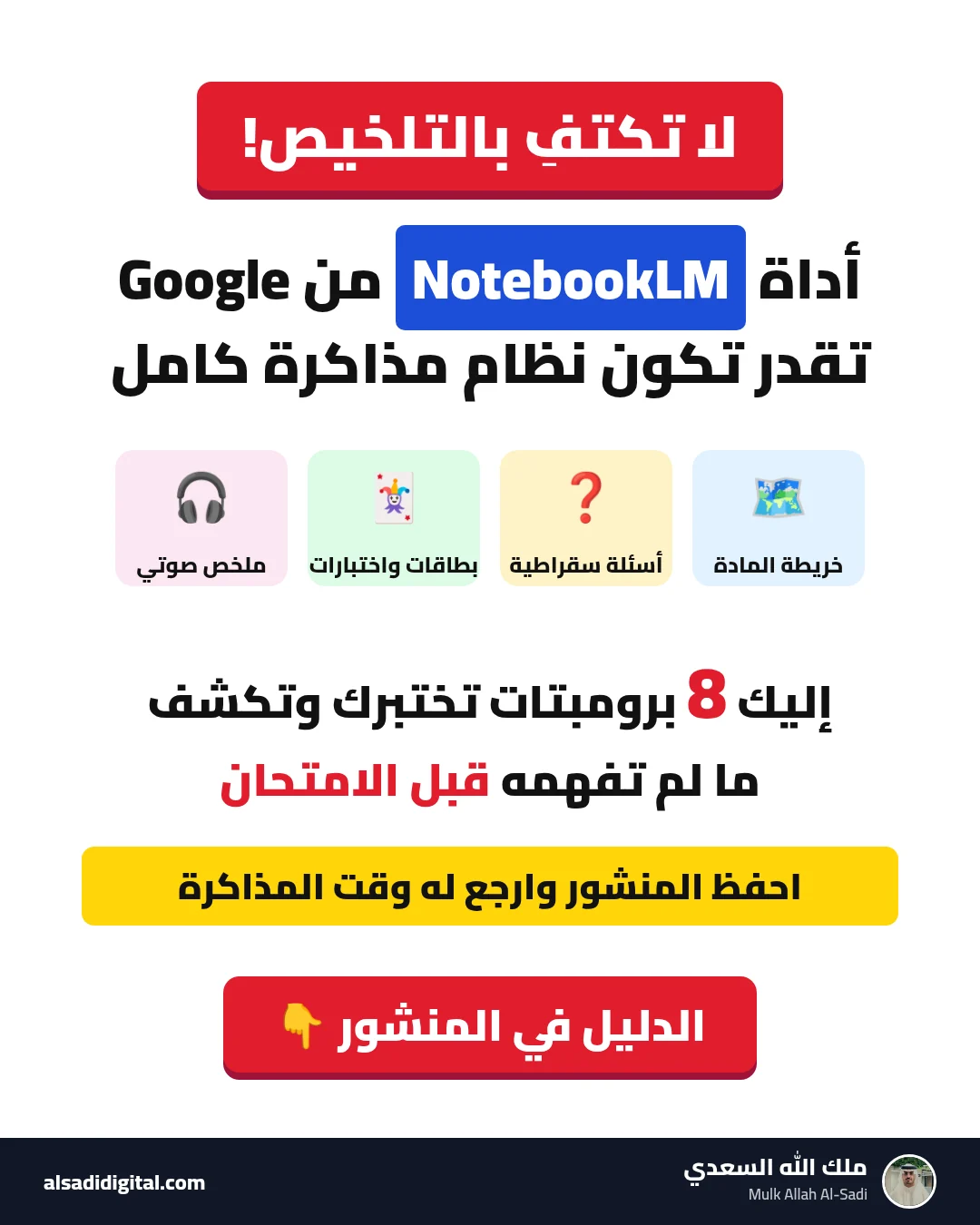
What you will get
After this guide you will turn any course’s files into an active study system: a clear course map, quizzes that expose your weak spots, corrections to your own explanations, past-exam pattern analysis, plus flashcards and a customised Audio Overview, with every answer linked to its source in your files.
A summary gives you the feeling of understanding, but exams measure your ability to recall and apply. That is why the strongest way to study is to be tested and to explain things yourself, not to read another summary. This is where Google’s NotebookLM stands out: its answers are grounded in the sources you upload, with citations that jump to the original passage, which reduces made-up answers.
What to know before you start
The tool runs in the browser at notebooklm.google.com, and Google’s newer Help pages call it Gemini Notebook. Create one notebook per course and upload lectures, PDFs, notes, slides and video links. According to the Help pages, the free plan currently allows 50 sources per notebook, with daily limits on Audio Overviews, flashcards and quizzes, and these limits may change.
In the Studio panel you will find Audio Overviews in formats such as Deep Dive, The Brief, The Critique and The Debate, mind maps, reports such as a study guide and FAQ, and flashcards and quizzes whose difficulty you can set and which accept your own instructions. The prompts below go in the chat or in the customisation box.
The eight prompts
Using only the sources, create a map of [course name]:
1. The main topics in a logical learning order.
2. Under each topic: the core concepts and what must be understood first.
3. Concepts that recur across several lectures (usually the most important).
4. Label each topic: core / intermediate / detail.
5. Suggest a study order for the [number] days before the exam.
Cite the source for each topic, and if something is not in the sources, say so.
When to use it: Your first session after uploading all the course files.
What to expect: The main topics and the concepts under each, how they connect and what comes first, with citations to where they appear in your files.
Be a Socratic tutor on [topic], using only the sources.
- Ask me one question at a time and wait for my answer.
- Start with comprehension, then application, then analysis, then comparison.
- If I am wrong: do not give the answer; give a hint and point to the source to review.
- If I am right: ask me to justify it with an example.
- After 8 questions: summarise my strengths, weaknesses and what to redo.
When to use it: After a first read of a topic, to find out whether you really understood it.
What to expect: One question at a time, moving from understanding to application, with feedback on your answer and a hint instead of the solution, pointing to what to review.
I will explain [concept] in my own words without looking at the files:
"[write your explanation here]"

Compare my explanation with the sources:
1. What is correct.
2. What important parts are missing, and where they are in the sources.
3. What is wrong or imprecise, and why.
4. One question to check that I fixed my understanding.
Do not rewrite the explanation for me; I want to correct it myself.
When to use it: To test deep understanding of a hard concept; one of the strongest ways to make it stick.
What to expect: A comparison of your explanation with the sources: what is right, what is missing and what is wrong, quoting the source.
I uploaded past exams for [course] alongside the lecture files.
1. Create a table: topic | number of exam questions on it | question type (definition, problem, comparison, case analysis) | years.
2. Which topics recur most, and which lecture topics never appeared in exams?
3. What phrasing patterns recur?
4. Write 5 new questions in the same style on the heaviest topics, without answers.
Note: this analyses the past and does not guarantee the next exam’s questions.
When to use it: If you have past exams or quizzes, upload them as sources in the same notebook.
What to expect: A table of question patterns, topic weights and recurring question types, plus new practice questions in the same style.
My weak spots in this course, from my review sessions: [list them].
Create a study guide focused only on these:
1. For each: a short, plain explanation from the sources.
2. One worked example from or based on the sources.
3. The common mistake with this concept and how to avoid it.
4. Two quick check questions.
5. A spaced-review schedule: when to revisit each point over [number] days.
When to use it: After the question and explanation sessions, to focus only on what you are missing.
What to expect: A short guide focused on the concepts you got wrong, with examples from the sources and quick review questions.
Compare the sources in this notebook on [topic]:
1. A table: concept | how each source presents it | any difference in definition, notation or method?
2. What do they all agree on?
3. Where do they differ, and what is the likely reason (level, convention, simplification)?
4. If the lecture differs from the textbook, clearly mark what the lecture says, since exams usually follow it.
Cite the source in every cell.
When to use it: When you combine a textbook, lectures and extra references that may differ in definitions or methods.
What to expect: A table of topics where the sources differ and how each presents them, flagging what your instructor uses.
Create a new, realistic scenario that requires applying [concepts] from the sources, at [easy/medium/hard] difficulty.
- Show only the scenario and the task, then wait for my solution.
- After I answer: assess each step and point to the principle in the sources that makes it right or wrong.
- Then give me a slightly harder scenario that targets the mistake I made.
When to use it: In applied courses, to move from memorising to using the concept.
What to expect: A new scenario that needs the concepts from your sources, step-by-step feedback on your solution, and the principle you missed.
The listener is a [year/level] student revising for a [course] exam in [number] days.
Focus only on: [topics or weak spots].
- Explain each concept with one practical example.
- Cover common mistakes and the differences between similar concepts.
- Pause after each topic and pose a question for the listener to think about before answering it.
- Skip side details and long introductions.
When to use it: For revision while walking or commuting. Paste this into the customisation box before generating an Audio Overview.
What to expect: An episode focused on what you asked for, at the level you set. Voices and content are AI-generated and can contain errors, so check any key point in the source.
Follow-ups and using Studio
- Generate Flashcards on "hard" and add the instruction "focus on definitions and differences between similar concepts", then review only the cards you missed.
- Generate a Quiz two days before the exam and note the wrong answers to take back to prompt 3.
- Use The Debate format for Audio Overviews on topics with multiple viewpoints.
- "Which past-exam question resembles this scenario, and how is it different?"
Common mistakes
- Relying on summaries and Audio Overviews without testing yourself.
- Mixing unrelated files in one notebook so answers blur; one notebook per course.
- Not clicking citations to verify important points.
- Asking for the answer straight away during Socratic sessions.
- Uploading protected material you have no right to share into a shared notebook.
Quick workflow checklist
- One notebook per course; upload lectures, notes and past exams.
- Map and priorities (1).
- For each topic: Socratic questions (2), then explain in your words (3).
- Analyse past exams (4) and apply to cases (7).
- A guide for weak spots (5); compare sources when they differ (6).
- Flashcards, a quiz and a customised Audio Overview (8) in the final days.
More articles

Stop Collecting Resource Lists: A 4-Week Roadmap to Learn AI Agents from Free Official Sources, Plus Eight Prompts to Build Your First Agent
“Top 50 resources” lists about AI agents get saved and never read. This guide picks just four free official sources, orders them into a four-week plan that ends with a small working agent, and gives you eight ready-to-copy prompts.
Mulk Allah Al-Sadi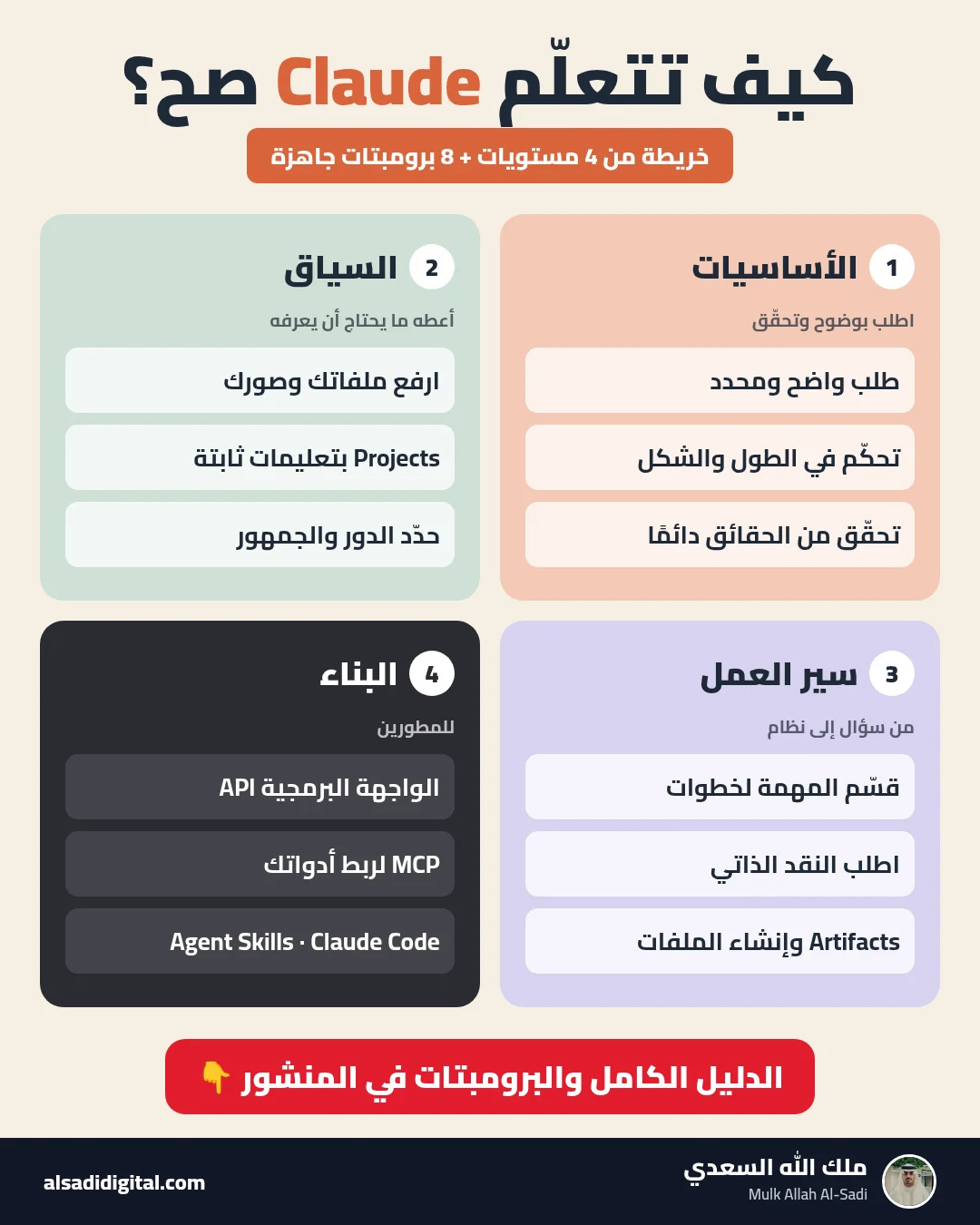
Learn Claude the Right Way: A Four-Level Map and Eight Prompts That Turn It into a Team of Experts
Skip the random experiments: a clear map of what to learn at each level of Claude, plus eight copy-ready prompts that make it work as your researcher, analyst, advisor, critic and tutor.
Mulk Allah Al-Sadi
Start Data Analytics from Zero: Cisco’s Free Data Analytics Essentials Course and Eight Prompts That Make AI Your Personal Coach
A practical guide to completing Cisco’s free data analytics course (Excel, SQL and Tableau) with real understanding, plus eight prompts for studying, practising, publishing a GitHub project and preparing for interviews.
Mulk Allah Al-Sadi