
Claude for Academic Research: Eight Prompts That Turn Dozens of Papers into a Review Matrix and Clear Research Gaps
A complete research workflow with Claude: building a search strategy, dissecting each paper, building the literature matrix, finding gaps and critiquing methods, with eight precise prompts that prevent fabrication.
 Mulk Allah Al-Sadi7 min read

What you will get
You will leave with a workflow that turns a set of papers into an organised comparison matrix, a list of gaps and proposed research questions, using prompts that force Claude to cite the page and stop it from inventing references.
My interest in AI for healthcare and education means reading a lot of research, and the hardest part is never finding papers but organising them: what does each say, where do they agree or disagree, and what has nobody studied yet? Claude is a very strong assistant here, on one condition: you give it the papers yourself and force it to cite where each point comes from.
The rule behind every prompt below: Claude reads, organises and analyses what you upload, but it is not a reference database. Never ask it for sources from memory; it may produce titles and authors that do not exist.
Setup: one Project per review
Create a Claude Project named after your review topic, upload the papers as PDFs, and put in the project instructions: your research question, inclusion and exclusion criteria, and the rule “cite the file and page after every point, and flag any outside knowledge”. You stop re-explaining in every chat, and every analysis stays grounded in the same sources.
The eight prompts
You are a research librarian specialising in [field].

My research question: [question]
Time range: [e.g. last 5 years]
Language: [language]

Deliver:
1. Split the question into 2-4 key concepts.
2. For each concept: synonyms, related terms and common abbreviations.
3. A boolean search string using AND, OR and quotation marks, adapted for Google Scholar, PubMed and [another database].
4. Three ways to narrow results if there are too many, and three ways to widen them if there are too few.

Do not suggest specific papers or references; I want the search strategy only.
When to use it: Before collecting any paper, so you search Google Scholar, PubMed or IEEE Xplore with precise terms instead of guessing.
What to expect: Your question’s concepts, synonyms for each, and ready boolean strings (AND/OR) per database, plus ways to narrow or widen. The results themselves come from the database, not from Claude.
Read the attached paper [file name] and extract a card in exactly this format:

- Reference: title, authors, year as printed in the paper.
- Study question and aim.
- Study type and method.
- Sample: size, characteristics, where data was collected.
- Instruments and measures used.
- Key findings with numbers as reported.
- Limitations stated by the authors.
- Additional limitations you notice (in a separate item called "Reviewer notes").

After each item write (p. [number]). If the paper does not say something, write "not reported". Do not fill gaps from general knowledge.
When to use it: For every important paper, to get a consistent extraction instead of a generic summary.
What to expect: A structured card: question, method, sample, findings and limitations, with a page number for each item and clear gaps where the paper says nothing.
Build a literature review matrix for the papers uploaded to this project.

Columns: Reference (author, year) | Country/context | Method | Sample size | Variables | Main finding | Key limitation.

After the table:
1. Three recurring trends, naming the supporting papers for each.
2. Any contradictions between findings, with possible explanations (sample, method or context differences).
3. Dominant methods and missing methods.

Cite (author, year, p.) for every claim. If there are many papers, start with the first [5] and wait for my go-ahead.
When to use it: After uploading five or more papers, to build the comparison table at the heart of any literature review.
What to expect: A table with a row per paper and fixed columns, then an analysis of trends and contradictions. With many papers, work in batches.
Using only the review matrix above:

1. Identify research gaps and classify them as: context gap (country or setting not studied), population gap, method gap, variable or outcome gap.
2. For each gap: the evidence from the matrix (which papers and why).
3. For each gap, propose one precisely worded research question and a suitable method.
4. Rate each question for originality, feasibility for a [bachelor's/master's] student within [time frame], and required resources.

Warn me explicitly if a gap may be covered by papers I have not uploaded, and suggest how to check.
When to use it: After building the matrix, when you are looking for an original contribution for your project or thesis.
What to expect: Gaps classified by context, population, method and variable, with evidence from the matrix, then actionable research questions for each.
Act as a peer reviewer specialising in research methods in [field].

Assess the methodology of [file name] for:
1. Fit between design and research question.
2. Sample: size, selection method, generalisability.
3. Internal validity: confounders and possible biases.
4. Instruments: does the paper report their validity and reliability?
5. Statistical analysis: does it suit the data, and do the numbers support the stated conclusions?
6. Conflicts of interest and funding, if reported.

Finish with a confidence rating (high/medium/low) with three reasons, and what I should state as a limitation if I cite this paper. Cite the page for each note.
When to use it: When you need to know whether a paper’s results are trustworthy before building on them.
What to expect: A structured assessment of internal and external validity and possible biases, with an overall confidence rating and clear reasons.
I am a [level] student in [field]. In [file name], page [number], it says: "[paste the sentence or table]".

Explain:
1. What this test or concept is and why it was used here specifically.
2. What the reported numbers mean in this case, in plain language.
3. What this result does NOT mean (common misinterpretations).
4. An everyday example that makes the idea concrete.

Then ask me one question to check I understood.
When to use it: When a paper uses a statistical test or methodological term you do not understand.
What to expect: A step-by-step plain-language explanation tied to the numbers in that paper, plus a question to check your understanding.
Draft the literature review section using the matrix above and my outline:
<outline>
Theme 1: [...]
Theme 2: [...]
Theme 3: [...]
My view of the literature: [your own conclusion]
</outline>

Rules:
- Organise by theme, not by paper, and connect studies (consistent with, contrasts with, extends).
- Cite only papers in the matrix as (author, year).
- Add no study or number that is not in the matrix.
- End each theme with a sentence leading to the gap my research addresses.
- Length: about [number] words, clear academic style.
When to use it: After you have written your own main points and need draft paragraphs organised by theme, not paper by paper.
What to expect: Paragraphs organised by theme that connect studies, citing only the matrix. Treat it as a draft to rewrite in your voice.
Act as a strict reviewer for a peer-reviewed journal in [field]. This is my draft:
<draft>
[paste or upload the draft]
</draft>

Write a review report with:
1. A 3-line summary of what the paper claims (so I can check my message is clear).
2. Numbered major issues (logic, method, evidence).
3. Minor issues (clarity, organisation, language).
4. Claims that need evidence or a citation.
5. A recommended decision (accept, minor revision, major revision, reject) with the reason.

Be specific: name the paragraph or line for every comment.
When to use it: Before sending your draft to your supervisor or a journal.
What to expect: Comments as a strict reviewer would write them: major and minor issues, questions and a recommended decision, so you anticipate criticism.
Follow-ups that raise quality
- "Check every citation in your previous answer: does the stated page actually contain the information? Fix any error."
- "Which points in your analysis relied on general knowledge rather than the files?"
- "Rebuild the table with an extra column for [the variable you need]."
- "Summarise the most important gap in one paragraph I can show my supervisor."
Common mistakes
- Asking Claude for references from memory instead of searching databases.
- Uploading a huge number of papers in one message and asking for a “comprehensive analysis”.
- Citing a paper based on Claude’s summary without opening it.
- Copying the draft as is; interpretation and final wording must be yours.
- Uploading participant or patient data to public tools, or ignoring your university’s or journal’s AI policy.
Quick workflow checklist
- Search strategy (prompt 1), then search the databases yourself.
- A review Project with the question, criteria and citation rule.
- A card per paper (2), then the matrix (3), then the gaps (4).
- Method critique for key papers (5) and explanations for anything unclear (6).
- Write your themes and view, then the draft (7), then the review (8).
- Manually verify every citation and disclose AI use where required.
More articles

Stop Collecting Resource Lists: A 4-Week Roadmap to Learn AI Agents from Free Official Sources, Plus Eight Prompts to Build Your First Agent
“Top 50 resources” lists about AI agents get saved and never read. This guide picks just four free official sources, orders them into a four-week plan that ends with a small working agent, and gives you eight ready-to-copy prompts.
Mulk Allah Al-Sadi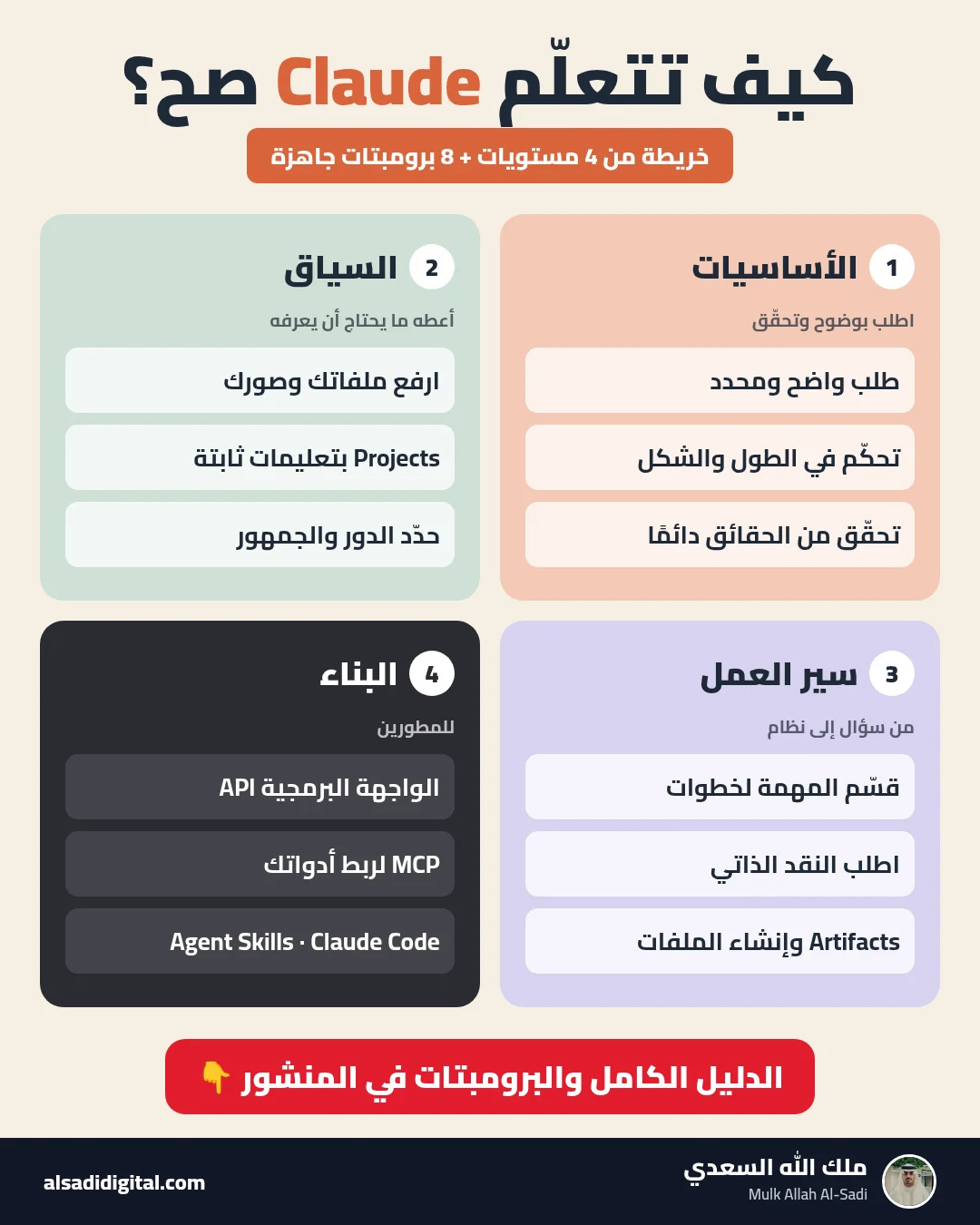
Learn Claude the Right Way: A Four-Level Map and Eight Prompts That Turn It into a Team of Experts
Skip the random experiments: a clear map of what to learn at each level of Claude, plus eight copy-ready prompts that make it work as your researcher, analyst, advisor, critic and tutor.
Mulk Allah Al-Sadi
Start Data Analytics from Zero: Cisco’s Free Data Analytics Essentials Course and Eight Prompts That Make AI Your Personal Coach
A practical guide to completing Cisco’s free data analytics course (Excel, SQL and Tableau) with real understanding, plus eight prompts for studying, practising, publishing a GitHub project and preparing for interviews.
Mulk Allah Al-Sadi