
Anthropic’s Free Courses: Which One Fits You, What Order to Take Them In, and Eight Prompts That Turn Every Lesson Into a Skill and a Project
Anthropic offers a set of free courses on Claude and AI, from the basics to the API, Claude Code and MCP. This is a practical guide to choosing your path, plus eight prompts that make you leave each course with a skill and a project, not just a certificate.
 Mulk Allah Al-Sadi7 min read
What you will get
After this guide you will know which free Anthropic courses to start with for your goal, in what order, and how to turn every lesson into practice, a quiz and a small project, then into a post that honestly documents what you learned.
The biggest problem with free courses is not their quality but how we study them: we rush through the videos, get the certificate, and forget most of it within a week. The fix is to give every course a practical output you build while studying.
Where the courses are and what they offer
Anthropic hosts its courses at anthropic.skilljar.com, and anthropic.com/learn redirects to its learning portal. The courses are free and need an account on the platform, and several show a “certificate of completion” when you finish. Check each course page before starting, because the content and the list are updated regularly.
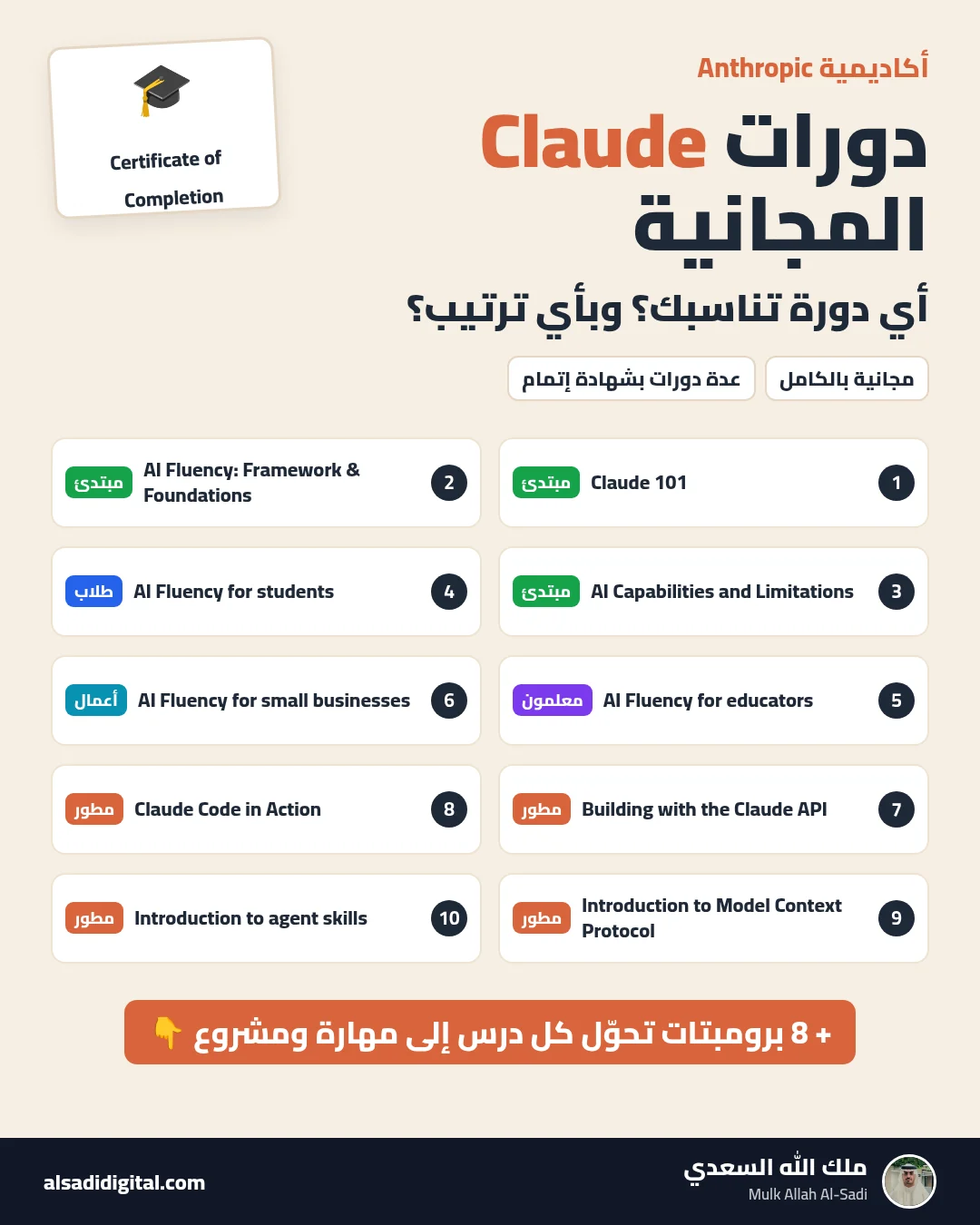
These are the main courses in the catalogue at the time of writing, grouped by goal:
- For everyone and beginners: Claude 101, AI Fluency: Framework & Foundations, AI Capabilities and Limitations.
- For students and teachers: AI Fluency for students, AI Fluency for educators.
- For business owners and specialised fields: AI Fluency for small businesses, for creative work and for nonprofits.
- For developers: Building with the Claude API, Claude Platform 101, Claude Code 101, Claude Code in Action.
- For building tools and agents: Introduction to Model Context Protocol, then Model Context Protocol: Advanced Topics, Introduction to agent skills, Introduction to subagents.
A suggested order
Non-programmers: start with Claude 101, then AI Fluency: Framework & Foundations, then the specialised course for your field. Developers: Claude 101 quickly, then Building with the Claude API, then Claude Code 101 and Claude Code in Action, then MCP and skills. Do not enrol in more than two courses at a time.
The eight prompts
This is the list of free Anthropic Academy courses I am considering:
[paste course names from the catalogue]

About me:
- Background: [student/employee/developer... and programming level]
- Goal within 3 months: [e.g. use Claude at work / build an app with the API]
- Time per week: [hours]

1. Pick 3-4 courses for me, in order, with a reason for each.
2. Which courses should I postpone, and why?
3. Suggest one final project that combines what I will learn.
Rely only on the course names in the list, and if you need details about a course’s content, tell me to check it.
When to use it: Before enrolling in any course.
What to expect: A path of 3-4 courses in order with a reason for each, a final project that ties them together, and what you can postpone.
I will take these courses in order: [list]. I have [number] hours a week across [days].
Create a plan for [number] weeks:
- For each week: the lessons, the hands-on practice, and a tangible output at the end.
- Spend at least 40% of the time practising, not watching.
- Add a review day every two weeks.
- A fallback if I miss a week, without the schedule collapsing.
When to use it: After choosing your path, so you actually finish it.
What to expect: A weekly schedule of sessions with a concrete output at the end of each week, plus a fallback for busy weeks.
I finished a lesson called [lesson title] in [course name]. These are my notes:
[paste notes]

1. Correct my understanding: what is accurate and what is missing? (Tell me if you are unsure about the course’s actual content.)
2. Give me 3 graded exercises applying the idea to [my field: work / a course / a project].
3. What criterion would prove I have mastered this idea?
4. What mistake do beginners usually make on this topic?
When to use it: Right after each lesson, in the same session.
What to expect: Corrections to your own short summary, three graded exercises on your work or studies, and a clear criterion for knowing you have mastered the idea.
Quiz me on [module topic] from [course name], based on these notes:
[paste notes]

- 6 questions, one at a time, waiting for my answer.
- Two on concepts, two on application, two "what would you do if...".
- After each answer: a brief correction.
- At the end: what should I redo before moving on?
When to use it: At the end of each module, before starting the next.
What to expect: One question at a time focused on understanding and application, then a report of what to review.
I have done parts of Building with the Claude API and want to build my first real app.
Language: [Python/TypeScript]. App idea: [e.g. a tool that summarises meeting notes and extracts tasks].

Be a mentor, not a code writer:
1. Split the project into 5 small stages, each testable.
2. For each stage: what is needed, which concepts from the course I will use, and how to test it.
3. I will write the code myself and paste it; review it and point out mistakes without rewriting it all.
4. Warn me about security practices: keep the API key in environment variables, never push it to GitHub, and control cost.
Start with stage one only.
When to use it: During or after Building with the Claude API.
What to expect: A small plan for a real app, a file structure, and staged steps where you write the code yourself with review, plus security warnings about your API key.
I am [my programming level] and about to start Introduction to Model Context Protocol.
1. Explain MCP with a simple analogy, then with the correct terms (client, server, tools, resources).
2. What problem does it solve, and when do I not need it?
3. Suggest 3 ideas for a small MCP server that fits my level and serves [my field], ordered from easiest.
4. Which parts should I verify in the official docs because they may change?
Do not invent function or package names; if you are unsure, say so.
When to use it: Before or during Introduction to Model Context Protocol.
What to expect: An analogy first, then the correct terms, a small MCP server idea that fits your level, and a list of what to check in the official docs.
I finished [course name]. Key things I learned: [list].
My field or interest: [...]. Time available: [number] hours.

1. Suggest 3 small projects that prove what I learned, each with: the problem, the output, and why it fits the course.
2. For the one I choose: clear acceptance criteria (when it counts as done) and a build plan in hours.
3. What to show on GitHub or my portfolio: README, screenshots, a short description.
When to use it: In the last week of each course.
What to expect: Three scoped project ideas, acceptance criteria, a short build plan, and what to show in your portfolio.
I finished [course name] from Anthropic Academy and built [project description].
3 things I really learned: [...]
A challenge I hit and how I solved it: [...]
Project link: [...]

Write a 120-180 word first-person LinkedIn post:
- Open with what I built or learned, not "I am thrilled to announce".
- Mention the course as the source of learning without overstating the certificate.
- End with a question for readers.
Write two versions: calm and professional, and more enthusiastic. Do not add any achievement I did not mention.
When to use it: After finishing the course and the project, not before.
What to expect: A short post in your voice focused on what you actually built and learned, without hype, in two tones.
Useful follow-ups
- "Rephrase this concept with an example from [my field]."
- "How does what I learned here differ from the next course in my path?"
- "Review my project README as a technical recruiter."
- "Create review flashcards from my notes for this module."
Common mistakes
- Enrolling in every course at once and finishing none.
- Watching lessons without practising the same day.
- Relying on Claude to describe a course you have not taken; it may get details wrong.
- Making the certificate the goal instead of the project and the skill.
- Pushing your API key to a public repository while experimenting.
Quick workflow checklist
- Open anthropic.skilljar.com and create an account.
- Choose your path (1) and weekly plan (2).
- After each lesson: practice (3); after each module: quiz (4).
- Developers: first API app (5) and understanding MCP (6).
- A capstone project per course (7).
- A post documenting your learning (8) after the project.
More articles

Stop Collecting Resource Lists: A 4-Week Roadmap to Learn AI Agents from Free Official Sources, Plus Eight Prompts to Build Your First Agent
“Top 50 resources” lists about AI agents get saved and never read. This guide picks just four free official sources, orders them into a four-week plan that ends with a small working agent, and gives you eight ready-to-copy prompts.
Mulk Allah Al-Sadi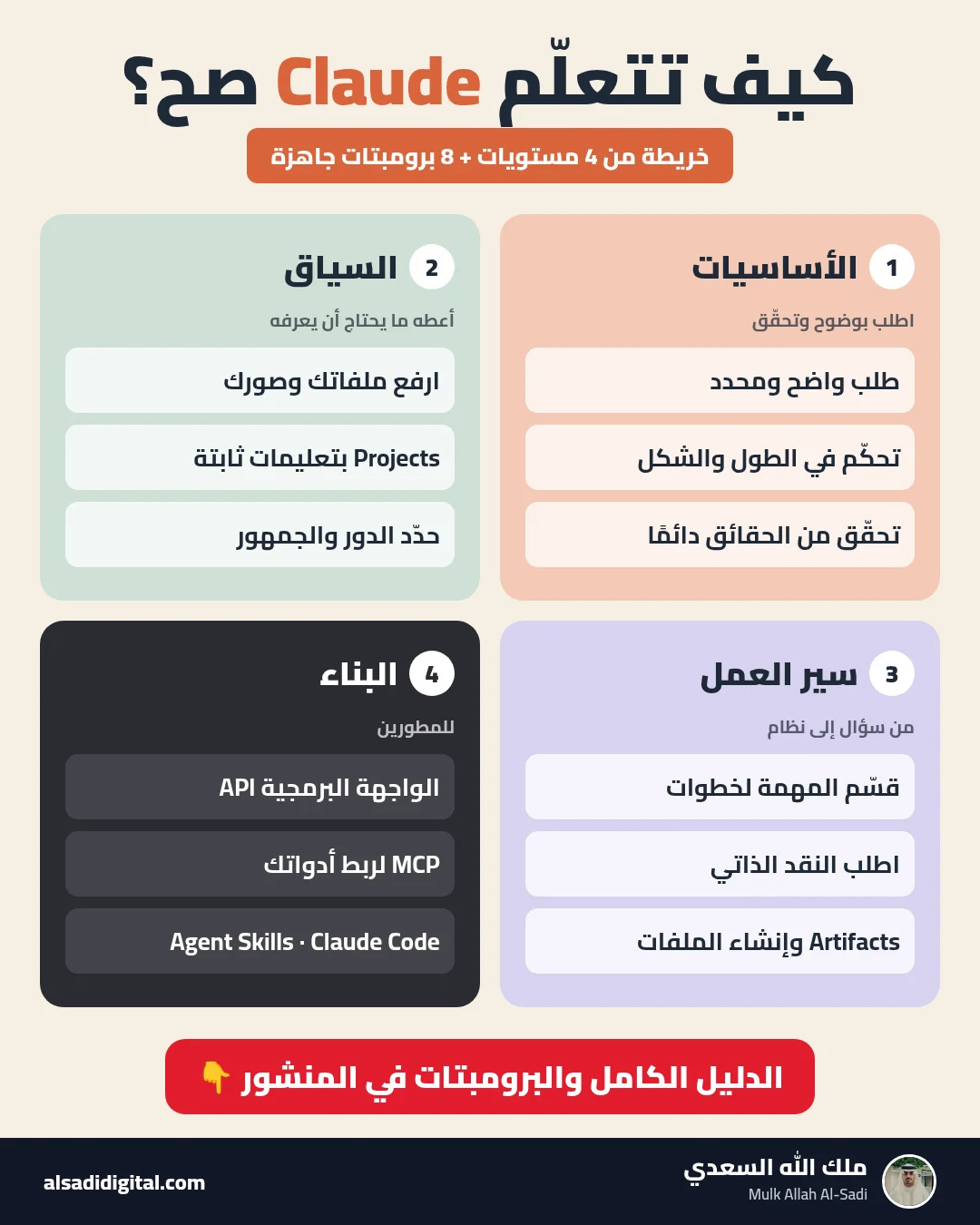
Learn Claude the Right Way: A Four-Level Map and Eight Prompts That Turn It into a Team of Experts
Skip the random experiments: a clear map of what to learn at each level of Claude, plus eight copy-ready prompts that make it work as your researcher, analyst, advisor, critic and tutor.
Mulk Allah Al-Sadi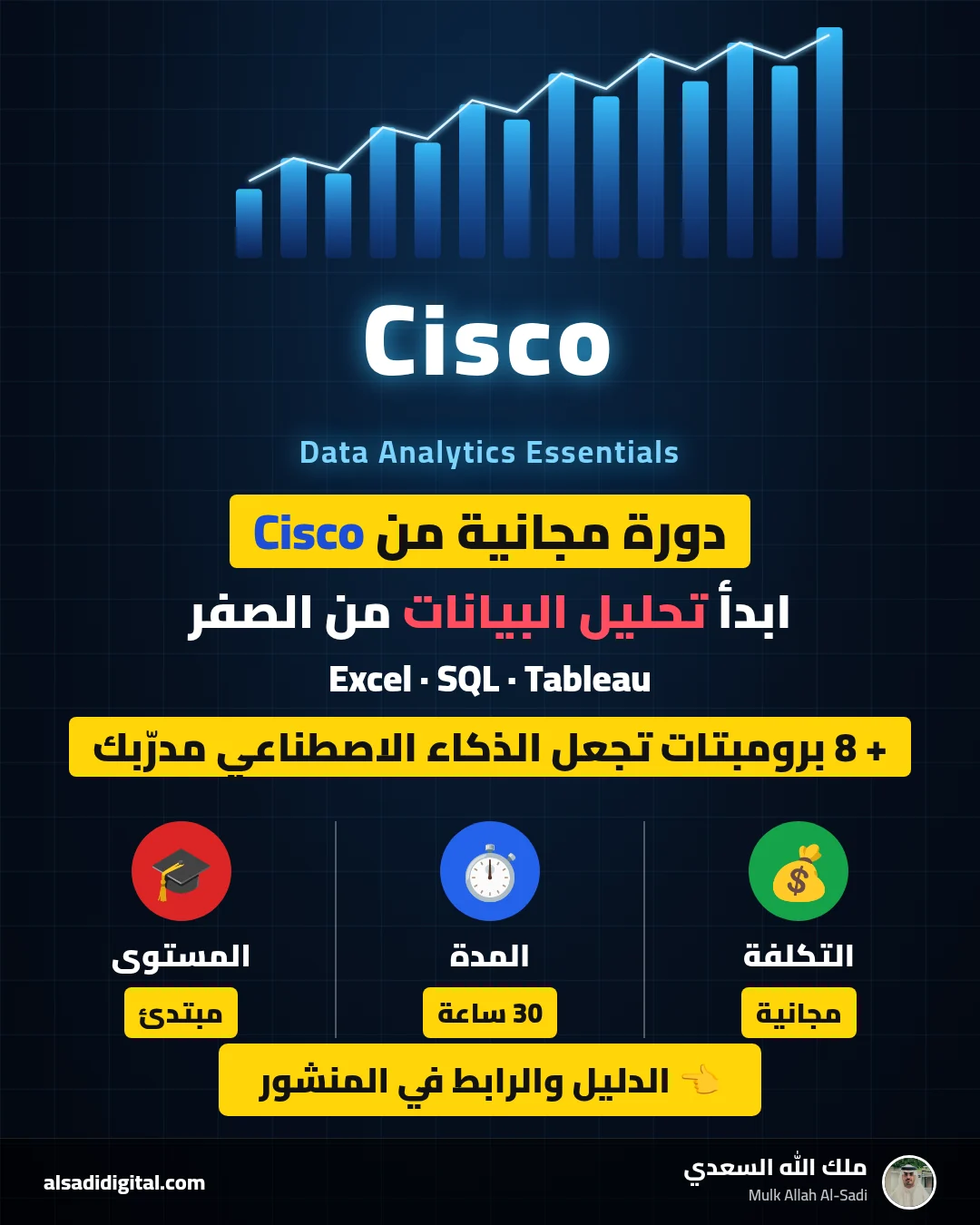
Start Data Analytics from Zero: Cisco’s Free Data Analytics Essentials Course and Eight Prompts That Make AI Your Personal Coach
A practical guide to completing Cisco’s free data analytics course (Excel, SQL and Tableau) with real understanding, plus eight prompts for studying, practising, publishing a GitHub project and preparing for interviews.
Mulk Allah Al-Sadi